Filed under: Press | Tags: NME Magazine, Press, Steve Lamacq, Trashcan Sinatras
In Steve Lamacq’s world they may well have drifted into the land of obscurity, but back in 1990 he wrote about big things to come for the Trashcan Sinatras.
Here’s what he had to say in his NME article from March 1990…
“Rock bands try and clobber you over the head with their image. Like Texas and Deacon Blue come in, ‘f___ing hell, it’s us, we’re like this, BUY US YOU STUPID BASTARDS!’ And people do. And you think, oh no, it’s happened again…”
“And yet there are bands who just meander along without shoving themselves down your throat. They just do their own thing and you kind of stumble upon it.”
You’ll have done well if you’ve stumbled across the TRASH CAN SINATRAS so far, seeing as their debut single, called (funnily enough) ‘Obscurity Knocks’ has been widely ignored by DJs in favour of bright new hopefuls like Yell and Cliff Richard.
To fill you in: the Trash Cans are a shy, subtle five-piece ‘pop’ group from Irvine, Scotland. They’ve just played some selected dates with They Might Be Giants and the single ‘Obscurity Knocks’ is out on Go! Discs.
Like in the FA Cup draws, the first person you heard from was guitarist John Douglas; the away team is drawn by other guitarist Paul Livingston.
“As a first single,” says John, “we thought it was a funny title, like tempting fate. It’s going to come true the way things are going.”
With more than a hint of self-depreciation, the Trash Can Sinatras are the first Scots band for a while to hark back (albeit unintentionally) to the charm and refreshing brightness of the Postcard era which brought you Orange Juice and Aztec Camera, almost a decade ago.
The Trash Cans wouldn’t have been out of place alongside fledgling Edwyns and Roddys, but with their singular, sad guitar strumming style they more importantly have a role to play now.
“Postcard just went away,” confirms John. “Before that, there was always a kind of muso scene in Glasgow which liked the American soul thing and then there was the wee punk guys who thought, ‘f___ this, let’s arse about’.
“But then there was the backlash to it and it faded out – Postcard was almost ignored in Scotland apart from the people involved in it: everyone else went back to soul music or (grimace) heavy metal.”
Having attracted the interest of the majors since birth, the Trash Cans slyly signed with Go! Discs, warning at the time that it’d take them a while to sort themselves out recording wise.
It did. They did the single, then they did it again. And then they did it once more, delaying it from last summer until now.
‘Obscurity Knocks’ is a camera snap-shot of the Trash Cans’ talents, starting off with a sprightly acoustic intro and leading through a series of reflective verses into a stumpy chorus.
In the same way that they like XTC, a very English pop group, there’s a definite Scottish flavour to the Trash Cans, a funny, natural bunch.
 Straight in at number 8…
 3 March 1990 NME Magazine Follow @fivehungryjoes
The official US press kit for second album, ‘I’ve Seen Everything’ came in the form of a band photograph and written press release…

“Some bands are really good at contriving an image for themselves, but we’re hopeless at that kind of thing,” says Paul Livingston of Scotland’s perpetually self-effacing TRASH CAN SINATRAS. “We just like good songs.”
Indeed, the youthful quintet – singer Frank Reader, guitarists John Douglas and Paul Livingston, drummer Stephen Douglas and new bassist David Hughes – has always placed a decidedly unfashionable emphasis on quality control, a fact that will be obvious after one listen to the band’s sophomore London/Go! Discs’ release I’VE SEEN EVERYTHING. The album preserves the TRASH CAN SINATRAS’ trademark balance of deceptively upbeat melodicism and wicked lyric irony – first heard on their 1990 debut album CAKE – while decisively expanding the band’s artistic scope.
I’VE SEEN EVERYTHING – produced by Ray Shulman of Sundays, Ian McCulloch and Sugarcubes fame – presents fourteen new band-written tunes that add a worldlier, gently ironic edge to the band’s fresh-faced tunesmithery. From the bracing infectiousness of “Blood Rush” and “Hay Fever,” to the swirling dynamics of “Send For Henny” and “Easy Read,” it’s clear the TRASH CAN SINATRAS have come a long way without losing the qualities that made them so appealing in the first place.
“All we knew when we started this record,” Livingston offers, “was that we wanted more loud guitars and fewer jangly things. I think these songs may be a bit more personal than the ones on CAKE, and I also think this record sounds more like a band. CAKE was a load of different tunes recorded, and a lot of the tracks were just remixed demos. The songs on I’VE SEEN EVERYTHING were all recorded during the same sessions, so it sounds more like a real album.”
 I’VE SEEN EVERYTHING also sees the return of David Hughes, a founding member from the group’s early days as a loose covers combo. Hughes returned to the fold after predecessor George McDaid left to pursue his academic career. “We’ve known him for years,” Livingston says of Hughes. “He started hanging around again when George left, and the next thing we knew he was in the band.”
When the TRASH CAN SINATRAS formed in 1988, in the harbor town of Irvine on Scotland’s west coast, international pop stardom was the furthest thing from their minds. “It just kind of happened,” Livingston explains. “There just isn’t that much to do where we’re from. It started out as a casual thing, and eventually we started writing our own songs. But it didn’t really become serious until we got signed – it was like, “They’re giving us all this money, we’d better do something.”
The band members were still teenagers when they signed with England’s Go! Discs label, making an immediate U.K. splash with their bittersweetly infectious debut single “Obscurity Knocks” and its similarly well-received followup “Only Tongue Can Tell.” And the stateside release of CAKE won the fivesome an enthusiastic following in the U.S., where the band toured extensively. “Most of the letters we get seem to come from America,” Hughes points out.

Like its predecessor, I’VE SEEN EVERYTHING was recorded at the band’s own 24-track Shabby Road studio, located in nearby Kilmarnock. “It’s just down the road from where we live,” Livingston says. “It’s great recording there, because at the end of the night we can just go home, which is a lot better than spending three or four months in some strange city. We bought it with the money from our publishing deal; we originally intended to run it as a business for other bands to use as well, but there’s hardly any bands around, so we mainly just use it ourselves. It’s dead handy because we can just go in and try songs whenever we want.”
Through it all, the TRASH CAN SINATRAS maintain a quiet yet stubborn devotion to their muse. “We basically just like to write good tunes,” says Hughes. “That’s what drives us, and it all seems to come quite naturally. It’s not a conscious thing at all. We never really push ourselves in any direction; we just write and record, and this is what comes out.”
“I think we’re always gonna be doing this,” Livingston concludes. “Even if everybody started hating us and our record company chucked us off, we’d still write songs and make records for ourselves.”
 1993 Go! Discs/London/Polygram
…I’ve got writer’s block.
So there’s not much to say about this small advert from ‘Melody Maker’ promoting second single ‘Only Tongue Can Tell’.

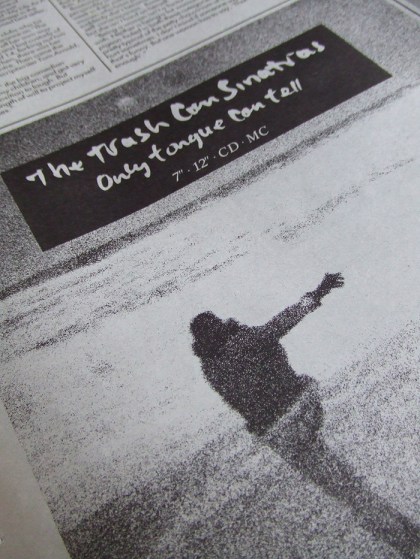 12 May 1990 Melody Maker
A small advert promoting second album, ‘I’ve Seen Everything’ which appeared in Melody Maker.
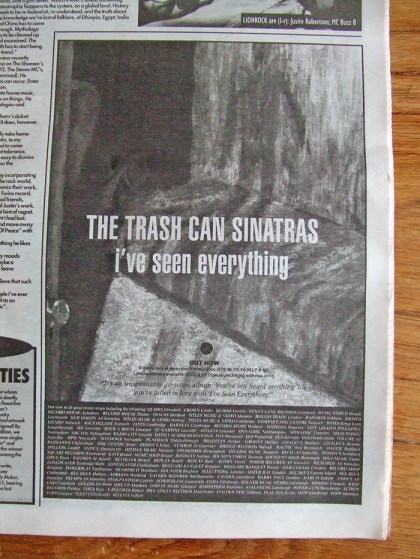 This advert also appeared in the same edition which included one of the anagram promos for ISE…
 8 May 1993 Melody Maker
Filed under: Press | Tags: Chris Roberts, Melody Maker, Press, Trashcan Sinatras
You bet he is! But hey, freedom of speech and all that.
Chris Roberts from Melody Maker obviously didn’t like the Trashcans’ second single, ‘Only Tongue Can Tell’
How dare he.
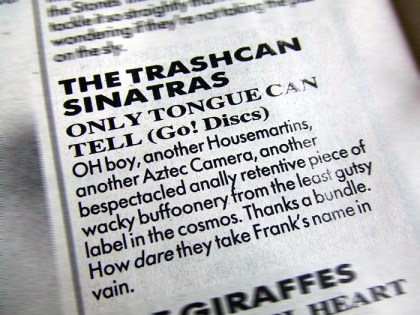 12 May 1990 Melody Maker
 Five Hungry Joes - A pictorial archive of the Trashcan Sinatras. Legendary Scottish Band