Filed under: Press | Tags: John MacFarlane, Press, Prince Charles Cinema, Spooktime, Trashcan Sinatras, Video promo
The Prince Charles Cinema is located in the West End of London and showcases cult, arthouse, and classic films alongside Hollywood blockbusters.
The cinema has achieved a cult status amongst fans, sticking out as the only independent cinema in the West End.
So it was quite appropriate that the Trashcans very own movie ‘Spooktime’ should be premiered at such a prestigious venue. As I’ve written before, this was the band’s 15 minutes of movie fame which took us all on a wee trip into Glasgow’s seedy gutter.
Thanks to Michael Rose – aka Marblehead Johnson – for sending through his invitation.
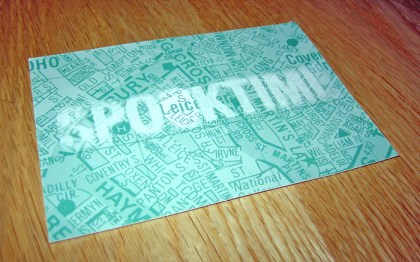
 23 April 1996
Filed under: Press | Tags: Concert, Dingwalls, Gig, Gilles Peterson, Press, Trashcan Sinatras
Here’s a flyer – thanks to Michael Rose – aka Marblehead Johnson – for sending it through – advertising a 1996 gig at Dingwalls, in support of third album ‘A Happy Pocket’.
Dingwalls is a venue adjacent to Camden Lock in London, England. It houses bars, cafes, clubs and is one of the city’s best known live music venues. It is possibly more renowned for the famous jazz dance club ‘Talkin Loud and Saying Something’ with Gilles Peterson and Patrick Forge.
Lovely shirts!


Here’s the ticket stub from the gig. Thanks to Stephen Lewis for the image. Little known fact: Stephen is the man who directed the videos for All The Dark Horses and also, I Hung My Harp Upon The Willows – a talented man I’m sure you’ll agree.
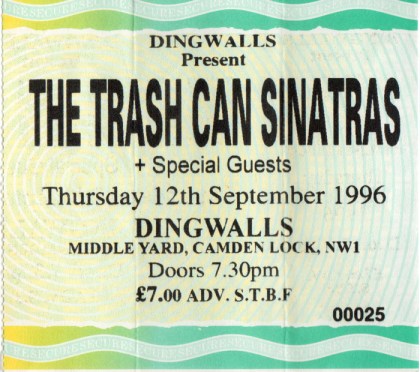 12 September 1996
A friend of mine – who thinks I’ve taken this blog too far – asked me if there has ever been a book written about the Trashcans.
The only one I was aware of, I said, was the AtoZ book by Finn Hartley which I’ve wrote about before.
But his question got me thinking. Apart from the usual discography encyclopedias, have the Trashcans been immortalised in print elsewhere? A quick googling and you’ll find the answer is yes.
Here’s what I found:
In 1993, Luis Alberto Urrea’s “Across The Wire – Life and Hard Times on the Mexican Border”, offers a compelling and unprecedented look at what life is like for those refugees living on the Mexican side of the US border.

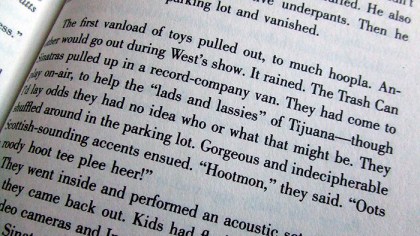
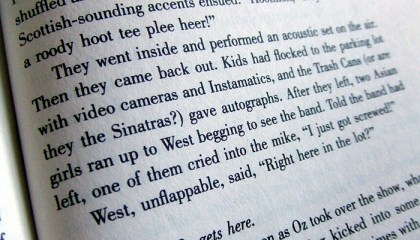
In 2000, James S. Rich’s “Cut My Hair”, tells the story of a young boy growing up in California and how love and music affects his life.

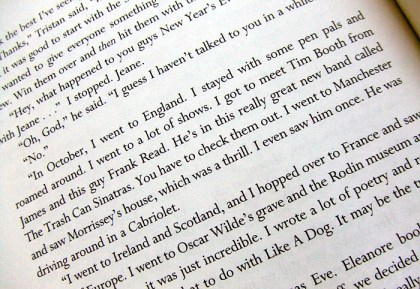
In 2002, Harry Turtledove’s “Counting Up Counting Down”, a collection of science fiction, fantasy and alternate history tales…


In 2001, A. S. Salinas’ “Songs For Drella and Other Disharmonies”, a collection of science fiction short stories. A dozen tales of lunacy and madness, populated by the usual cast of losers and misfits offering poor role-modeling for today’s youth.


And finally, in 2003, John D. Wells’, “The Barfly Boys” documents the trials and tribulations of four young men in Charlottesville, Virginia trying to keep alive their dreams of rock ‘n roll stardom.


So there you have it, the Trashcan Sinatras really are immortal, thanks to some talented writers.
There was one other book I came across which had something to do with XML computer mark-up language. I didn’t include that one – that really would be taking it too far.
Filed under: Press | Tags: Magazine, Music, Press, Rolling Stone Magazine, Trashcan Sinatras
This advert promoting debut album ‘Cake’ appeared in an issue of Rolling Stone magazine.
I’ve no idea which one.
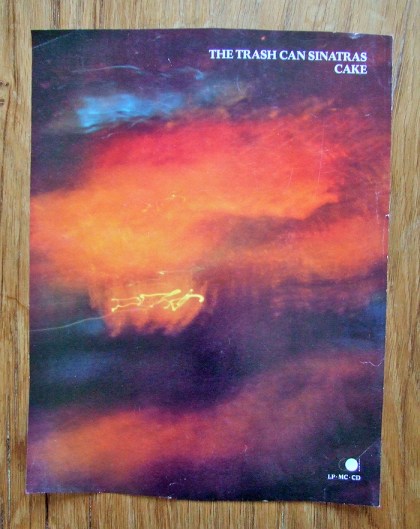 1990 Rolling Stone Magazine
Filed under: Press | Tags: Magazine, Melody Maker, Music, Press, Trashcan Sinatras
…in this article from the Melody Maker.

Read all about it…
DAVE JENNINGS meets the Scottish band who hope to twist pop into new and exciting shapes with their debut album ‘Cake’.
“LOOK, YOU LIVE ON THE WEST COAST OF Scotland for 26 years, then write an album and see what it sounds like!”
John Douglas of The Trash Can Sinatras is responding sharply to the suggestion that “Cake”, his band’s debut album, is a gloomy affair. He knows the description is accurate, but he also knows there’s more to it than that. The Sinatras acknowledge that their Scottish smalltown background is reflected on the record, but John’s convinced that its concerns are universal.
“I know for a fact that the climate we’re writing about is not unique to Irvine. People all over the world go through that life. They go to school, it’s crap and they get f***ed off with it, they go and do shit jobs and get f***ed off with that, then they go and sit on the dole for a few years.”
But “Cake” isn’t as dour as John’s analysis implies. The name The Trash Can Sinatras, with its juxtaposition of the sordid and the untouchable, neatly illustrates the strongest tension in the group’s music. The album suggests a band with conflicting urges to create something transcendent and to tell the plain truth. Not that they’d ever talk about it in such terms – John and fellow guitarist Paul Livingston repeatedly stress the absence of contrivance in their work, insisting that they simply mess around in their Kilmarnock studio until another swooning pop tune appears.
Chris Roberts outraged the Sinatras a few weeks ago by suggesting in a single review that they were an archetypal product of the Go! Discs label. For me, there are some parallels with The Beautiful South in particular – the sense of drama, the old-fashioned melodic virtues, the sardonic use of standard pop devices. But John couldn’t agree less.
“The only person on Go! Discs that I feel an affinity with is Billy Bragg, and that’s because he writes what he feels and can sometimes write a really brilliant song. I’d shake his hand and buy him a drink any day of the week.”
YET the Sinatras’ excellent debut single “Obscurity Knocks” was an extravagant, towering pop epic, far removed from Bragg’s spartan style; and the imminent new release “Circling The Circumference” is both noisy and precise, turbulent and flowing. The Sinatras’ melodies and lyrics are always pieced together with obvious attention to detail. As their current slogan says, “The Cliche Kills”. Over-familiar language smothers excitement and excludes new ideas. So The Trash Can Sinatras are fighting back, twisting standard pop writing till it snaps and bites.
“You know” says John, “that if someone comes up with a song called ‘I Love You’ they’ve got to be pretty dodgy. We know the value of a good lyric – how it can touch you, how it can move you, how it can make you think. And a lot of people seem to have forgotten that.”
Mainly, of course, because dance culture has made the lyricist’s craft unfashionable.
“You’re right,” Douglas concurs, “it’s unfashionable. There’s people who write great lyrics who don’t get as much attention as they deserve – like Fatima Mansions, and Band Of Holy Joy.”
As a live attraction, The Trash Can Sinatras have changed dramatically since their first London date a couple of months ago. Frontman Frank Read has changed from a petrified figure standing still, shivering and clutching his mike-stand for comfort to an almost Iggy Pop-like self-destructive spectacle. These days they demand your attention.
“We’d like people to recognise that we’re here, we’re doing this and it’s good – so that we can say, ‘Yes, we know it’s good, so what are you listening to that shit for?” declares John. “That must be the great thing about being dead famous – you can tell everybody to f*** off!”
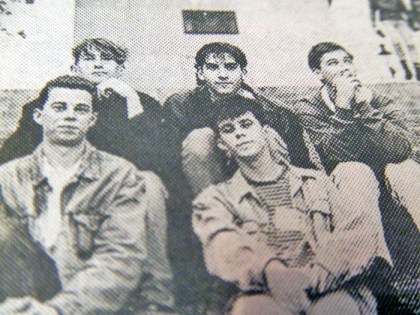 14 July 1990 Melody Maker
 Five Hungry Joes - A pictorial archive of the Trashcan Sinatras. Legendary Scottish Band