Filed under: Press | Tags: Album Reviews, Magazine, Press, Record Mirror, Trashcan Sinatras
…but plenty of chocolate – was how Johnny Dee summed up debut album, ‘Cake’.
A bit of a cliché perhaps, but he still gives it pass marks in his review for Record Mirror…
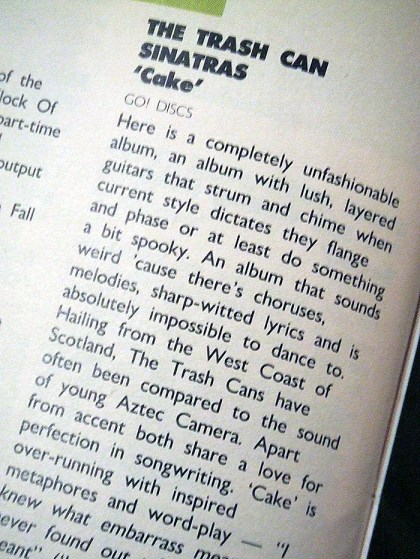
The review appeared alongside a full page advert for the album too…

 30 June 1990 Record Mirror
Filed under: Press | Tags: Cake Magazine, Music, Press, Trashcan Sinatras
I’m afraid I don’t know that much about CAKE magazine. Only that it’s based in Minneapolis MN, and is a bit similar to the NME here in the UK.
But this article by John Speakman did appear in the Summer of 1993.
Enjoy…

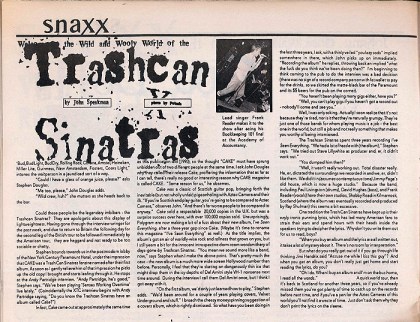
‘Bud, Bud Light, Bud Dry, Rolling Rock, Corona, Amstel, Heineken, Miller Lite, Guinness, New Amsterdam, Fosters, Coors Light,” intones the waitperson in a jaundiced sort of a way.
“Could I have a glass of orange juice, please?” asks Stephen Douglas.
“Me too, please,” John Douglas adds.
“Wild crew, huh?” she mutters as she heads back to the bar.
Could these people be the legendary imbibers – the Trashcan Sinatras? They are apologetic about this display of lightweightness. Having gone through the interview wringer for the past week, and due to return to Britain the following day for the second leg of the British tour to be followed immediately by the American tour, they are haggard and not ready to be too sociable or chatty.
Stephen bounds towards us in the postmodern lobby of the New York Century Paramount Hotel, under the impression that CAKE was a Trash Can Sinatras fanzine named after their first album. As soon as I gently relieve him of that impression he picks up the old copy I brought and starts leafing through it. He stops at the Andy Partridge interview. “Andy Partridge, he’s good,” Stephen says. “We’ve been playing ‘Senses Working Overtime’ live lately.” (Coincidentally the XTC interview begins with Andy Partridge saying, “Do you know the Trashcan Sinatras have an album called Cake?”)

In fact, Cake came out at approximately the same time as this publication did (1990), so the thought “CAKE” must have sprung unbidden out of two different people at the same time. I ask John Douglas why they called their release Cake, proffering the information that as far as I can tell, there’s really no good or interesting reason why CAKE magazine is called CAKE. “Same reason for us,” he observes.
Cake was a classic of Scottish guitar pop, bringing forth the inevitable (but not wholly unfair) pigeonholing with Aztec Camera and their ilk. “If you’re Scottish and play guitar, you’re going to be compared to Aztec Camera,” observes John. “And there’s far worse people to be compared to anyway.” Cake sold a respectable 20,000 copies in the U.K. but was a surprise success over here,with over 100,000 copies sold. Unsurprisingly, Polygram are now making a bit of a fuss about their new album, I’ve Seen Everything, after a three year gap since Cake. (Maybe it’s time to rename this magazine “I’ve Seen Everything” as well.) As the title implies, the album’s got an air of worldly-wise rock and rollness that grows on you, but I still yearn a bit for the innocent introspective dorm room wordsmithery of days-gone-by Trashcan Sinatras. “you mean we sound more like a band, now,” says Stephen when I make the above point. That’s pretty much the case – the new album is a much more wide screen Hollywood number than before. Personally, I feel that they’re skating on dangerously thin ice that might drop them in the icy depths of Del Amitri style VH-1 nonsense next time around. During the interview I call them Del Amitri once, but I think I got away with it.
“On the first album, we’d only just learned how to play,” Stephen adds. “We’d been around for a couple of years playing covers, Velvet Underground and stuff.” I broach the cheesy moneyspinning suggestion of a covers album, which is rightly dismissed. So what have you been doing the last three years, I ask, with a thinly veiled “you lazy sods” implied somewhere in there, which John picks up on immediately. “Recording the album” he replies, throwing back an implied “what the fuck do you think we’ve been doing then?” I’m beginning to think coming to the pub to do the interview was a bad decision (there was no sign of a record company person with fat wallet to pay for the drinks, so we skirted the matte-black bar of the Paramount and its $5 beers for the pub on the corner).
“You haven’t been playing many gigs either, have you?”
“Well, you can’t play gigs if you haven’t got a record out – nobody’ll come and see you.”
Well, I was only asking. Actually I soon realize that’s it’s not because they’re tired, nor is it that they’re naturally grumpy. They’re just one of those bands for whom playing music is a job – the best one in the world, but still a job and not really something that makes you worthy of being interviewed.
The Trashcan Sinatras spent three years recording I’ve Seen Everything. “We had a lot of hassle with (the album),” Stephen says. “We tried out Steve Lillywhite as producer and, er, it didn’t work out.”
“You dumped him then?”
“Well, it wasn’t really working out. Total disaster really. He, er, dictated the surroundings we recorded in and we, er, didn’t like them. We did it in (assumes contemptuous tone) Jimmy Page’s old house, which is now a huge studio.” Because the band, including Paul Livingston (drums), David Hughes (bass), and Frank Reader (vocals) have their own studios, Shabby Road in Kilmarnock, Scotland (where the album was eventually recorded and produced by Ray Shulman) this seems a bit excessive.

…stop! Hammertime. Doooo-doo-be-doo…
One tradition the Trash Can Sinatras have kept up is their wryly ironic punning lyrics, which has led many American fans to strain their ears and spend hours with their heads inside the speakers trying to decipher the lyrics. Why don’t you write them out for us to read, boys?
“When you buy an album and the lyrics are all written out, it takes away a lot of the mystery about it. There’s no room for interpretation.”
But what do you really get out of it if you go through life thinking Jimi Hendrix said “Accuse me while I kiss this guy”? And when you get an album, you don’t really just get home and start reading the lyrics, do you?”
“Oh I do. When I buy an album and I’m on the bus home, I read all the words.” states John.
A quick world tour, then it’s back to Scotland for another three years, so if you’ve already missed them you’ve got plenty of time to catch up on the records before next time, and if you’ve a yen for the Aztec Cameras of this world you’ll not find it a waste of time. Just don’t ask them why they don’t print the lyrics on the sleeve. John Speakman
 Cake Magazine Issue No.16, late Summer 1993 (US)
Filed under: Press | Tags: Les Inrockuptibles, Magazine, Music, Press, Trashcan Sinatras
Les Inrockuptibles is a French art criticism magazine. The magazine was instrumental in popularising indie rock music with bands such as The Smiths and The House of Love. They produced several tribute records, including the influential ‘I’m Your Fan’ to Leonard Cohen in 1991 and ‘The Smiths Is Dead’ in 1996.
Here’s a cutting taken from the magazine promoting second album, ‘I’ve Seen Everything’.
 Les Inrockuptibles Magazine 1993 (FRA)
Filed under: Press | Tags: Cake Magazine, Magazine, Music, Press, Trashcan Sinatras
Here’s a half page advert taken from Minneapolis based music magazine ‘Cake’ to promote the release of second album ‘I’ve Seen Everything’.
I’m not familiar with this magazine, but it’s a bit like the UK’s NME.
 Cake Magazine Issue No.16, late Summer 1993 (US)
Filed under: Press | Tags: Album Reviews, NME Magazine, Press, Trashcan Sinatras
6 out of 10 was what NME’s Roger Morton gave the Trashcans’ debut long player, ‘Cake’, but after reading his review, that could have been a misprint.
Here’s what he had to say…
IT MUST be tough to say no in the groove-pushing ’90s. With Morrissey missing, presumed vacillating, and surrounded on all sides by computer-looters, psychedelic organ-grinders and remixed up kids, you must be pretty bloody-minded to set up stall in the nation’s rhythm-blasted shopping centre under a huge banner proclaiming ‘Like Funk Never Happened’.
This, however, is precisely what The Trash Can Sinatras, Scotland’s newest traditionalist songwriters and accidental conscientious objectors to Club Culture, have done with their first album. They must be very determined, or very depressed.
‘Cake’ has some good things going for it. The first is that there is nothing conspicuously Scottish about it. Bluster free and bereft of local namechecks in the lyrics, TCS speak to us in the Esperanto of well-crafted, harmony-kissed, pastoral pop. If their acoustic strumming and afraid-to-rock recalcitrance connect them with early ’80s Postcard label Scots, as is often claimed, then it also serves to make friendly signs at a mixed batch of nimble pluckers and hummers, from Bradford to The La’s to The Housemartins.
The key word here is ‘sensitivity’. TCS bicycle through this album, clear-eyed and sober-headed, smothering you with mother lovable three part vocal sweetness, and attacking their guitars with the savagery of macrame mat makers. They are about as raving as a string quartet and as rock’n’roll as a bunch of Christian birdwatchers on a canal boating holiday, but they are capable of achieving a swooning, scintillant, petal strewn mix of elation and poignancy that makes you want to…what?
In the case of their pleading, propulsive first single ‘Obscurity Knocks’, it makes you want to act like Mozzer doing ‘This Charming Man’. Elsewhere, on ‘Maybe I Should Drive’ their rattle ‘n’ chime is sturdily beat braced, allowing for folkish anthemic possibilities, and ‘Even The Odd’ swings along in pleasantly dreamy fashion with a touch of Smiths-ian booming guitars.
There are, then, positive things to be said of The Sinatras refusenik situations. Bereft of any fad trappings and with Roses’ producer John Leckie opting to emphasise clarity and naturalism, the focus is all on the songs. It is sort of brave, but on this first album it has a lot of drawbacks too. When they’re good, the songs have the sort of deceptive simplicity that’s come to be expected from The Beautiful South (singer Frank Read has a touch of Paul Heaton’s wholesome crooning style to him).
The lullabye strum of ‘Funny’ has both the necessary wisdom “I know she doesn’t play the field/But she likes to know the strength of the team” and weirdness, to keep things a bit challenging: “She’s a funny kind of girl/Set sail in a ship in a bottle/She’s a funny kind of girl/And do the Swiss fake it when they yodel?”. What the hell does that mean?
Too many maudlin minor chord changes, too many “Give me the strength to face another lazy day” type lines and they start to sound just depressed. Midway through ‘Cake’ you might find yourself accidentally humming songs by the favourite TCS comparison, Aztec Camera, and realising that if they’re going to breathe life back into literate, jangling waif pop, the Sinatras still have a long way to go. Roger Morton
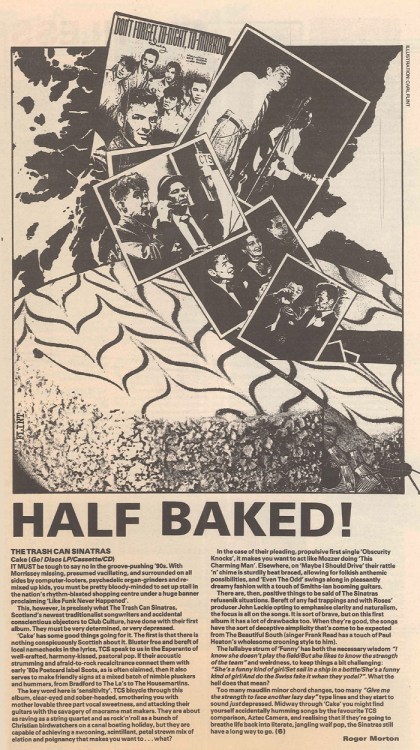 30 June 1990 NME Magazine
 Five Hungry Joes - A pictorial archive of the Trashcan Sinatras. Legendary Scottish Band